Acne may be temporary, but the changes it leaves behind can remain visible long after breakouts have settled. Non surgical acne scar treatment is not one single procedure. It is a carefully planned approach that considers the type of scar, your skin tone, active acne history, lifestyle, healing capacity, and the amount of improvement that feels meaningful to you.
At Natural Beauty Clinic, we approach scar revision with the same goal we bring to all aesthetic care: healthier-looking skin, natural-looking results, and recommendations grounded in a thorough assessment. For many patients, the most effective plan combines more than one modality over time rather than relying on a single treatment.
Why acne scars need an individualized approach
Acne scars are not all alike. Some are shallow and broad, while others are narrow, deep, or accompanied by uneven color. The right treatment depends less on how noticeable a scar feels in the mirror and more on its structure beneath the surface.
Atrophic scars are indented scars caused by a loss of collagen during the healing process. Rolling scars create soft, wave-like depressions and may be tethered below the skin. Boxcar scars tend to have wider, more defined edges. Ice-pick scars are narrow and deep, often requiring a different strategy than broader textural scars.
Discoloration can also be mistaken for scarring. Red or brown marks after acne may fade gradually, but they do not always respond to the same treatments used for indentations. Some people have both texture changes and post-inflammatory pigment changes, which is why an in-person skin assessment is so valuable.
Non surgical acne scar treatment starts with skin health
Before recommending collagen-stimulating treatments, we consider whether acne is active and whether the skin barrier is stable. Treating scars while inflammatory acne is still recurring can be frustrating, as new breakouts may create new marks and disrupt progress.
We also look at factors that can influence skin quality and recovery, including sun exposure, skincare habits, inflammation, hormonal patterns, nutrition, medications, and relevant medical history. An integrative approach does not replace appropriate dermatologic care, but it can help us understand the broader factors that may affect the skin’s appearance and healing response.
For patients with a tendency toward pigmentation, especially after inflammation or procedures, preparation and conservative treatment settings may be particularly important. The goal is not simply to create a stronger treatment response. It is to choose a plan that respects the skin and supports steady, well-managed improvement.
Treatment options that may improve acne scar texture
HELIX CO2 laser resurfacing
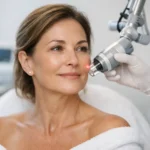
Fractional CO2 laser resurfacing creates controlled micro-injuries in the skin to stimulate remodeling and renewal. It can be a valuable option for certain patients with textural irregularities, fine lines, enlarged pores, and more established acne scarring.
HELIX CO2 laser treatments can be tailored in intensity, but stronger resurfacing generally involves more downtime and a more involved recovery period. Redness, swelling, peeling, and sensitivity are expected parts of the healing process. This option may not be ideal when active acne, recent sun exposure, certain skin conditions, or a high risk of post-inflammatory pigmentation are present.
For the right candidate, laser resurfacing may support meaningful changes in texture over a series of treatments or as part of a combined scar-revision plan. Results develop gradually as the skin heals and produces new collagen.
Morpheus8 RF microneedling
Morpheus8 combines microneedling with radiofrequency energy delivered at controlled depths. The microchannels and thermal energy are designed to support collagen remodeling within deeper layers of the skin, making this modality useful for patients concerned with acne scars, pore appearance, uneven texture, and early laxity.
Compared with more aggressive laser resurfacing, RF microneedling may offer a different balance between visible downtime and treatment intensity. It still requires appropriate aftercare, sun protection, and individualized settings. Several sessions are often considered because collagen remodeling occurs gradually and acne scars rarely change in a uniform way after one visit.
Dermapen DP4 microneedling
Dermapen DP4 microneedling uses fine needles to create controlled microchannels in the skin. This treatment can support collagen induction and may be suitable for mild to moderate textural concerns, particularly when a patient prefers a more gradual approach or is not currently suited to laser resurfacing.
Microneedling is not a shortcut to instant smoothness. Its value is in progressive skin remodeling, and the response varies based on scar depth, skin biology, and adherence to aftercare. It may be used independently or incorporated into a broader treatment plan.
PRP and PRF as regenerative support
Platelet-rich plasma (PRP) and platelet-rich fibrin (PRF) use components derived from a patient’s own blood. In aesthetic care, they may be paired with microneedling or selected procedures to support the skin’s recovery environment.
These regenerative options are not replacements for energy-based scar treatments when deeper remodeling is needed. However, they may be considered as part of a personalized protocol for patients seeking support for skin quality and recovery. Suitability depends on health history, medications, treatment goals, and clinical judgment.
Skin boosters and supportive skin-quality care
When acne scars are subtle but skin is dehydrated, dull, or uneven, improving overall skin quality can make texture appear less pronounced. Selected skin boosters and a professionally guided home-care routine may support hydration, radiance, and barrier function.
This is an important distinction: improving skin quality may soften the appearance of certain concerns, but it does not necessarily correct deep, tethered scars. Honest treatment planning means matching the intervention to the structural issue rather than overselling a surface-level solution.
Combination treatment often makes sense
A person may have rolling scars on the cheeks, enlarged pores around the nose, residual brown marks along the jawline, and skin sensitivity from previous acne products. Treating all of these concerns with one device, one setting, or one appointment would rarely be the most thoughtful approach.
Combination care may involve alternating RF microneedling and laser resurfacing, using microneedling with PRP or PRF, or preparing the skin with a targeted skincare regimen before more intensive treatment. The sequence matters. We may prioritize acne stability and pigment control first, then introduce collagen-stimulating procedures once the skin is ready.
Treatment intervals also matter. Collagen remodeling takes time, and performing procedures too frequently can compromise recovery rather than improve results. A paced plan allows us to observe how your skin responds and make adjustments as needed.
What results and recovery can realistically look like
Non-surgical treatment may improve the appearance of acne scars, but complete removal is not a realistic promise. The degree of improvement depends on scar type and depth, the chosen treatment, the number of sessions, skin tone, age, genetics, sun exposure, and how the skin heals.
Most patients notice changes gradually. Early improvements may include smoother feel, better light reflection, and a more refined appearance of pores. Deeper scars often require more patience and may soften rather than disappear. Clinical photography can be useful because day-to-day mirror checks are not always a reliable way to see gradual progress.
Downtime varies. Dermapen DP4 and some RF microneedling protocols may involve short-term redness and sensitivity, while CO2 laser resurfacing may require more visible recovery. We review expected healing, aftercare, work and social scheduling, and sun-avoidance requirements before treatment so there are no surprises.
Choosing care with confidence
A safe, sophisticated acne scar plan begins with a consultation, not a device menu. We assess your scar pattern, current acne activity, pigmentation risk, medical history, skincare routine, and tolerance for downtime. We also discuss what improvement would feel worthwhile to you, because the most appropriate plan is one that aligns clinical opportunity with your real life.
For patients in White Rock, South Surrey, the Fraser Valley, Vancouver, and nearby Washington communities, physician-led assessment offers a considered path toward stronger skin quality without pursuing unnecessary treatment. Acne scars can be personal, but your care should never feel one-size-fits-all.
The next helpful step is simply to understand your skin clearly. With a measured plan and time for collagen to remodel, subtle changes can add up to skin that feels smoother, more even, and more like your own.